Red River Conditions
Live flow & weather · At the Dam · updated —
⚠️ These are live-data suggestions, not a safety guarantee — read this before you go
Everything here is generated from live public data (USGS river gauges and Open-Meteo weather) and is meant as a helpful starting point — a gauge reading and a suggestion, not an official flood forecast or dam-release schedule. Conditions on the Red River can change in minutes: the dam can release without much warning, sandbars shift, and the river rises fast.
Always confirm current conditions before you fish — check the official USGS gauge and NWS river forecast, and when in doubt, ask a game warden, a local guide, or the Corps of Engineers for up-to-date, knowledgeable information. Never rely on this widget alone for a safety decision. Heed the dam siren, watch the water, wear a life jacket, and don’t wade or launch when the river is high or rising.
Brannan’s Bass Shop provides this tool for general information only and assumes no liability for any accident, injury, loss, or damage arising from use of the river or reliance on this information. You fish and boat at your own risk.
Where You Can Actually Get to the River
Here's the honest truth nobody tells you: most of the Red River shoreline is private, posted land, and the shallow, sandbar-choked channel keeps normal boats off big stretches of it. That's why the river stays wild and uncrowded — and why you need to know the legal public access points before you go. Below are the real ones. When in doubt, get permission or go with a guide, and never assume a bank is open just because it looks empty. Tap any card for directions.
← Swipe or tap the arrows →
Denison Dam Site (below the dam)
Best public accessCorps campground · Multi-lane boat ramp (boats to 26 ft) · Wheelchair-accessible bank fishing · Restrooms/showers · Camping · Launch fee
This is the one to know. The U.S. Army Corps of Engineers runs a campground on the riverbank right below Denison Dam, and it's the best legal public access on this part of the Red — a multi-lane ramp, a wheelchair-accessible bank-fishing area, and you're standing on top of some of the best striper and trophy-catfish water in the Southwest, especially during the May spawn and after floods. From Denison, take Texas 91 north to the dam, then FM 1310 west about 300 yards to the park. Heed the siren and never wade past the marked cable below the outlet works.
Get directions →US-271 Boat Ramp (Grant, OK)
North of the shopPublic boat ramp · River access · Oklahoma side · Roughly 10 min north on US-271
A handy public ramp on the Oklahoma bank where US-271 crosses the Red near Grant, OK — only about ten minutes north of the shop, which makes it the closest quick-shot river access we've got. It puts you on a wilder, less-pressured stretch well downriver of the dam crowd, good for catfish in the bends and holes and for spotting rolling gar on the flats. It's a working ramp, not a park, so it can be rough and low when the river's down — check the flow first. Confirm current condition with us before you haul.
Get directions →Red River ATV Park (OK-78)
West / Albany bridge sideRiver access · Fishing & swimming allowed · Day-use parking · Restrooms & showers · Oklahoma side near the OK-78 bridge
On the Oklahoma bank right along the Red near the OK-78 bridge north of Bonham (the Albany-bridge side, out west of the shop), this off-road park sits directly on the river and allows fishing and swimming, with flat day-use parking, restrooms and showers. It's a legit, confirmed public way to get down to the water and put in a shallow-draft boat or fish the bank on a stretch that's otherwise walled off by private land. It's an OHV park, so expect some mud-bog activity — call ahead before you haul, and mind the river level.
Get directions →Carpenters Bluff Bridge
Historic put-inCanoe/kayak put-in · Bank access near the bridge · About 8–12 mi below the dam · Fly-fishing water
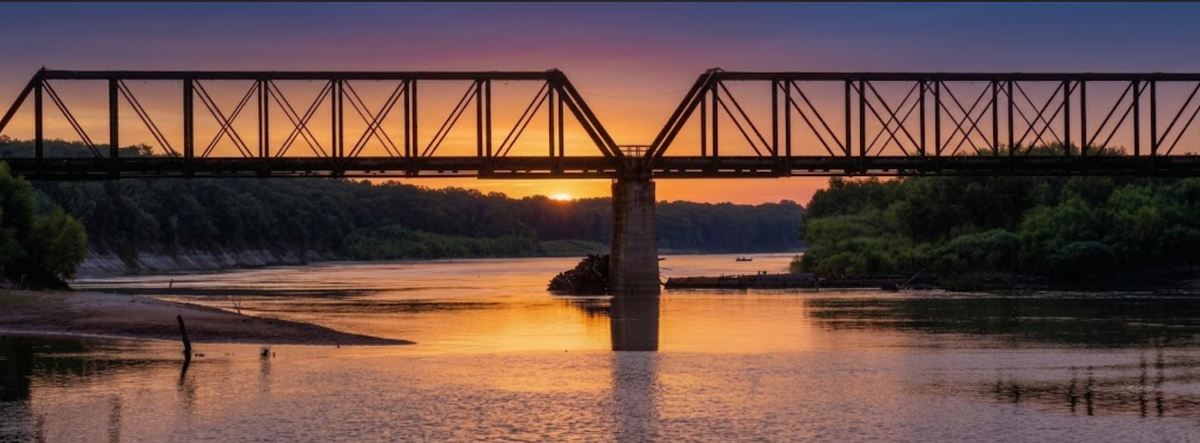
A local landmark — a 1910 railroad bridge (now a one-lane crossing) linking Grayson County, TX to Bryan County, OK, about 8 miles east of Denison off FM 120. The stretch from the dam down to Carpenters Bluff is classic fly-and-light-tackle water: curving loops, riffles and pools, and open gravel beaches to cast from. Paddlers put in here to float down toward Bonham. The bank access is a steep, narrow trail to a gravel beach — four-wheel drive helps, and it can be a wrestle to get back out. Respect that the land around it is private away from the crossing.
Get directions →Guided Airboat Trips
The way to fish the wild stretchesAccess to skinny water & remote holes · No ramp needed · Trophy blue-cat trips · Near Denison & Gainesville
For the miles of river that private land and sandbars keep off-limits to normal boats, an airboat is the answer — and it's how the biggest Red River blue cats get caught. Guides run shallow bars and skinny water for miles to reach untouched holes with no development, no crowds, and eagles overhead. If you want to experience the real Red without owning an airboat or trespassing, a guided trip is worth every penny and the fastest way to learn the river. We can point you to reputable Red River catfish guides.
Find guides →Access & License — Read This First
Don't get a ticketMost bank is private · Texoma license NOT valid below the dam · State line runs down the river · Watch the siren
Three things that'll save your trip. Access: the great majority of the Red's bank is private and posted — use the public points above, get landowner permission, or go with a guide; don't cross posted land to reach the water. License: the special Lake Texoma License is not valid below Denison Dam. On the river you need a regular Texas or Oklahoma license, and because the state line runs down the middle, wading out or fishing the far bank can put you in the other state — below the mouth of Shawnee Creek an Oklahoma license is required. Within the first 1,000 feet below the dam, tag your stringer with your name and license number and use no more than two rods. Safety: heed the generation siren, watch the rising water, and never wade past the restricted cable. Grab the right license and your gear at Brannan's before you go, and verify current rules with TPWD/ODWC.
Gear up at Brannan's →The Fish & How to Catch Them (in Current)
Blue Catfish — the river's trophy
Blue Catfish — the river's trophy
The Red River is legendary blue-cat water — the shad-rich, current-swept channel grows some absolute giants, and it's produced record-class fish, including a state junior-angler blue over 66 pounds. This is what most folks come for. Fish fresh cut shad on the bottom in the deep outside bends, the scoured holes below sandbars, and the eddies behind any current break. A three-way rig or a Santee-style rig that holds bottom in the flow is the standard, with enough weight to stay put in the current. The bite fires when the water's moving — after a rain, on a rise, and below the dam when they're generating. Drift the channel edges to cover water and find the schools, then anchor on the good holes. Come see us for fresh cut bait, heavy river rigs and the rod to handle a fish that fights the current all day.
Striped Bass — tailrace power
Striped Bass — tailrace power
Below Denison Dam the Red is one of the best striper spots in the Southwest, especially during the May spawn when fish run up out of the river and after big floods. When the dam generates and the current rips, the stripers stack in the tailrace to ambush shad getting swept downriver. Throw slabs and spoons into the current and work them back, swim a big shad-imitating soft plastic through the seams, or free-line a live shad in the flow. Topwater at first light when they're pushing bait can be electric. The bite is tied to the water: fish it hard while it's flowing and be ready to move as the level changes. Note the below-dam striper limit and the stringer-tagging rule within the first 1,000 feet of the dam — check current regs.
Alligator Gar — prehistoric giants
Alligator Gar — prehistoric giants
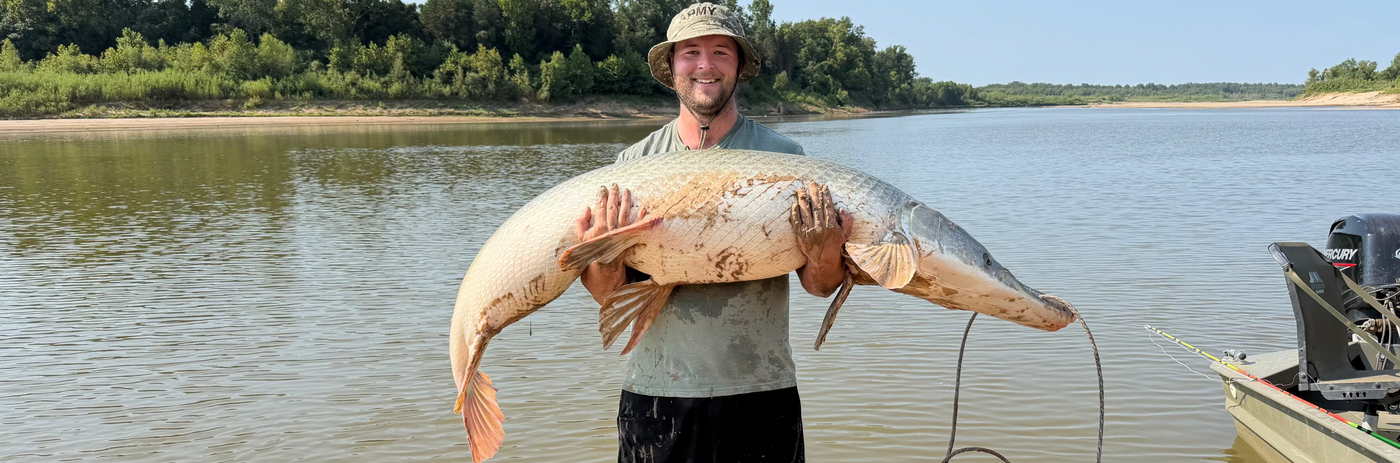
The Red River and its connection to Lake Texoma is one of the few places anywhere you can hunt a true alligator gar — living dinosaurs that top well over a hundred pounds. They cruise the slower pools, backwaters and the warm shallow flats, rolling and gulping air on calm days, which is exactly how you spot them. Two ways to get one: bowfishing (the most popular method on the Red, and we stock the gear) or heavy rod-and-reel. The old river trick for rod-and-reel is a wad of frayed nylon rope or a ball of line with a chunk of cut bait in the middle — no hook needed; the gar's teeth tangle in the fibers and you battle it in. Heavy tackle, wire or heavy mono, and patience. Know the rules: one alligator gar per day, mandatory 24-hour harvest reporting, and no take during the May spawn on the Red and Texoma. Handle these ancient fish with respect.
Paddlefish (Spoonbill) — the living fossil
Paddlefish (Spoonbill) — the living fossil
Here's one you won't find on a bass lake page: the paddlefish, or spoonbill, a filter-feeding living fossil with a long paddle-shaped snout that swims the Red below the dam. They're plankton eaters, so they don't chase a bait — the traditional way to catch them is snagging with weighted treble hooks where the regulations allow it, and the tailrace below Denison Dam is a known spot. Paddlefish are strictly regulated and seasons/methods differ by state and stretch, so this is a check-the-current-rules-first fish — but hooking one of these prehistoric giants in the current is an experience most anglers never get. If catch-and-release snagging or a paddlefish season is open, it's a bucket-list Red River adventure. Always confirm current TPWD/ODWC paddlefish regulations before you target them.
White Bass, Flatheads & More
White Bass, Flatheads & More
The Red gives up more than the headliners. White bass run the river in numbers, especially in spring and below the dam in the generation current — small slabs, spoons and in-line spinners in silver and chartreuse fill a cooler fast, and it's a blast for kids. Flathead catfish prowl the log jams, undercut banks and deep timber-filled holes and want live bait; they're the ambush predator of the river. Channel cats are everywhere, stacking at creek mouths after a rain. And you'll find longnose and spotted gar all through the system on top of the big alligator gar. It's a genuinely wild, diverse fishery — you never quite know what the current will hand you.
Season by Season- The River
River Tips & Safety
Know the generation schedule before you step in the water
Know the generation schedule before you step in the water
This is the one that saves lives. Below Denison Dam the river rises several feet in minutes when they generate power, and a siren sounds before the water comes up. Check the Corps generation schedule and the river gauge before you go, never wade past the marked restricted cable below the outlet works, keep an escape route to high ground, and the second you hear the horn, get out. The rising water is also the best bite of the day — so fish it smart, from a safe position, and let it come to you.
Time your fishing to the flow, not the clock
Time your fishing to the flow, not the clock
On a river, the water tells you when to fish. The bite fires when the current is moving — after a rain, on a rise, and below the dam during power generation, because moving water sweeps bait and triggers everything to feed. A dead, low, slack river is tough; a moving one is money. Learn to read the gauge and the generation schedule and you can show up exactly when it's going off.
Anchor and rig for current — heavier than you think
Anchor and rig for current — heavier than you think
Lake rigs don't hold on the Red. Use enough weight to keep your bait pinned in the flow (often 3–8 oz), a three-way or Santee-style rig so your bait rides just off bottom in the current, and a solid anchor with plenty of rope to hold in moving water. Braided line cuts the current and telegraphs the bite better than mono here. Come see us and we'll build you river rigs that actually hold.
Respect the sandbars — they can be quicksand
Respect the sandbars — they can be quicksand
Red River sand looks solid and isn't, especially where water is moving over or through it. Don't wade or walk out onto a wet bar you don't know, keep your weight spread, and never fish alone in a remote stretch without telling someone your plan. The riverbed also rearranges every flood, so last trip's safe route may not be safe now.
Match your boat to the river — or don't bring one
Match your boat to the river — or don't bring one
The Red's shallow, shifting, sandbar-choked channel eats lower units and strands prop boats. The folks who run it use airboats or shallow-draft jon boats, and plenty of anglers fish it from the bank or float it in a kayak or canoe. If you don't have the right rig, fish the public bank access, float a known stretch, or book a guided airboat trip — don't try to force a bass boat down the river.
Fresh cut shad beats everything for blues
Fresh cut shad beats everything for blues
For Red River blue cats, nothing out-fishes fresh cut shad or skipjack. Catch or buy it fresh, keep it cold, and re-bait often — the current washes the scent out fast. Fish it in the deep outside bends and the holes below sandbars. Grab your cut bait and heavy rigs from us on the way.
Two states, one river — mind the license line
Two states, one river — mind the license line
The state line runs right down the Red, so which license you need can change with where your bait lands. The Texoma license does NOT work below the dam. Carry the right Texas or Oklahoma license for the water you're fishing (Oklahoma below the mouth of Shawnee Creek), tag your stringer within 1,000 feet of the dam, and when in doubt, ask a game warden — they'd rather answer a question than write a ticket.
Bring more than you think — you're a long way from a store
Bring more than you think — you're a long way from a store
The Red is remote. Once you're on a river stretch there's no marina, no bait shop, no cell signal in places. Pack extra rigs, weights, bait, water, sun protection and a first-aid kit, tell someone your float plan, and load up everything before you leave Brannan's. Out here, forgetting one thing can end the trip.


Your Last Stop Before the River
Cut Bait, Heavy Rigs, Bowfishing Gear — Load Up Here
The Red is remote — no marina, no bait shop, no signal out there. Brannan's is your stop before you go: fresh cut bait, heavy river rigs and weights, braided line, bowfishing gear, and the right Texas or Oklahoma license (the Texoma license won't cut it below the dam). Grab a fresh report on the flow and the generation schedule, or order online and pick up on the way.
Brannan's Bass Shop · 10081 US-271, Powderly, TX 75473 ·
Open 7 days 6am-6pm
Frequently Asked Questions
Where can you fish the Red River near Denison?
Where can you fish the Red River near Denison?
The best public access is the U.S. Army Corps of Engineers area below Denison Dam, with a boat ramp, a wheelchair-accessible bank-fishing area and camping. Other confirmed public options include the US-271 boat ramp near Grant, OK (about 10 minutes north of the shop), the Red River ATV Park on OK-78 (fishing and river access allowed), and the Carpenters Bluff bridge put-in east of Denison. Most other Red River bank is private and posted, so use these public points, get landowner permission, or book a guided airboat trip — and confirm current access before you go.
Do I need a special license to fish the Red River?
Do I need a special license to fish the Red River?
Yes — and note the special Lake Texoma License is NOT valid below Denison Dam. On the river you need a regular Texas or Oklahoma fishing license depending on which water you're in, and because the state line runs down the river, wading out or fishing the far bank can put you in the other state. Below the mouth of Shawnee Creek an Oklahoma license is required. Always verify current TPWD/ODWC rules.
Is it safe to fish below Denison Dam?
Is it safe to fish below Denison Dam?
It can be, with respect. The hydroelectric plant releases water during power generation, raising the river several feet fast — a siren sounds first. Never wade past the marked restricted cable, watch the level, keep an escape to high ground, and get out when you hear the horn. That rising water is also the best bite of the day, so fish it from a safe position.
What fish are in the Red River?
What fish are in the Red River?
Trophy blue catfish are the calling card, plus flathead and channel cats, striped bass (especially in the tailrace below Denison Dam), white bass, alligator gar and other gar, and paddlefish (spoonbill). It's a wild, diverse, current-driven fishery.
Can you bowfish the Red River, and does Brannan's sell gear?
Can you bowfish the Red River, and does Brannan's sell gear?
Yes — bowfishing is one of the most popular ways to fish the Red, especially for alligator gar, other gar, carp and buffalo on the shallow flats, day or night. Brannan's carries bowfishing bows, reels, arrows and points. Bowfishing methods and seasons differ by state and stretch, alligator gar are one per day with mandatory reporting and a May closure, and rough fish taken by archery generally can't be released — check current rules.
How is river fishing different from lake fishing?
How is river fishing different from lake fishing?
The river moves. Instead of structure and cover on still water, you read current — the deep outside bends, holes below sandbars, eddies behind obstructions, and the seams where fast meets slow. You rig heavier to hold bottom in the flow, time the bite to the water moving, and navigate shifting sandbars. It's a different skill set and a wilder experience.
Is there a bait and tackle shop near the Red River?
Is there a bait and tackle shop near the Red River?
Gear up before you go — the river is remote with no marina or bait shop out there. Brannan's Bass Shop in Powderly stocks fresh cut bait, heavy river and catfish rigs, braided line, bowfishing gear, and the right license, plus a fresh report on the flow.
How does the Red River connect to Lake Texoma and the other lakes?
How does the Red River connect to Lake Texoma and the other lakes?
Lake Texoma is the Red River dammed at Denison Dam, and the tailrace below is where the river resumes. Hugo Lake feeds the Red through the Kiamichi River, and Pat Mayse and Bois d'Arc drain into the Red system through their creeks. Fish move through the whole watershed, which is why the river connects all the fishing in the region.