
The New Lake Everybody's Talking About
Fishing Bois d'Arc — Texas's Newest Big Water
We've watched Bois d'Arc go from a valley of cleared timber to 16,641 acres of some of the most exciting bass water in Texas. It's the first major reservoir the state has built in over 30 years — filled in 2021, stocked hard with selectively-bred Lonestar largemouth, and already kicking out double-digit fish while it's still young. About 40 minutes northwest of the shop up around Bonham, it's a different animal than our home lakes: thousands of acres of standing timber, a maze of man-made brush piles, and a whole lake full of hungry, fast-growing fish.
Here's the thing about a young lake — the fish haven't seen a million baits yet, and the giants are still on the way up. Get in now. Below we'll walk you through how to read new water, fish the timber without leaving your lower unit on a stump, use the habitat map to find fish fast, and — just as important — why turning the big ones loose is how this lake becomes a legend. Stop in for your license and tackle on the way; we'll tell you what's working.
Bois d'Arc Lake Bite Forecast
Live · updated —
Wind Directions Grandpa's Advice
-

Northern Wind- The fish come forth
The cold front just pushed through, Bass may still bite, but they can become less aggressive. Start around timber, protected points, creek-channel edges and cover with a jig, Texas rig, suspending jerkbait or slower-moving soft plastic.
-

Eastern Wind- The fish bite the least
Don't panic, adjust. Instead of abandoning the lake, fish the side where the wind is contacting a point, riprap or shoreline, then slow down if moving baits do not produce and consider throwing out your favorite Urchin from Brannan's.
-

Southern Wind- Fish bite the mouth
Warm southerly winds are common before fronts in Northeast Texas. Try spinnerbaits, bladed jigs, crankbaits, lipless crankbaits and swimbaits along wind-blown points and banks. A breeze can increase surface disturbance and position feeding activity near shoreline cover.
-

Western Wind- The fish bite the best
Fish On! Often times a storm system is on the way and the pressure is dropping.
Your excuse to start aggressive. Look for points, riprap, timber edges and banks getting hit directly by the wind. Bassmaster notes that banks receiving wind more directly can be particularly productive. -

When the Wind is Still- The fish are ill
Flat water often makes fish easier to spook and removes the surface disturbance that can help moving-bait fishing. Try worms, drop shots, Ned rigs, finesse jigs or subtle topwaters early, and target shade, timber, vegetation and deeper structure. Urchins are good back ups here.


What's Biting, Season by Season
-

Summer — Early Up, Then Offshore
Fish first light until about 9:30, then again the last two hours of daylight — topwater and buzzbaits around the timber early. Through the heat, the better bass pull out to 20–30 feet on offshore timber, channel swings and the mapped brush piles; probe them with Texas-rigged worms, football jigs and deep-diving crankbaits. White bass school early and late — small spoons, swimbaits and inline spinners. Crappie hold on brush in 10–20 feet, and the shaded FM 897 bridge pilings are the coolest seat in the house. This is a forward-facing-sonar lake in summer.
-

Fall — Chase the Shad
As it cools, everything keys on shad. Match the bait with shad-imitating lures — Alabama/umbrella rigs, spoons, lipless cranks, spinnerbaits and swimbaits — over flats, points and the edges of the timber. Crawfish-colored baits produce too. White bass and large mouth bass both gang up on schooling shad, so watch for surface activity and birds. Crappie stay on the brush and timber and feed hard before winter. Fast, fun, cover-water fishing.
-

Winter — Deep Brush & Big Ones
Winter is when that brush-pile map really pays. With the thermocline gone, fish stack on the deeper piles and submerged trees, and the big ones group up. Work deep structure with Carolina rigs, deep-diving crankbaits, heavy Texas rigs, skirted jigs and weighted swimbaits, and use forward-facing sonar to pick off suspended bass with an Alabama rig, flutter spoon or swimbait. Crappie sit deep on the brush too — vertical jigs and minnows. Dress warm, fish slow, and enjoy an empty new lake.
-

Spring — Timber Spawn & Numbers
Spring is the show on this lake. As the water climbs into the 58–65° range, bass push shallow into the flooded timber, protected coves and the gravel spawning beds TPWD built — throw soft plastics, spinnerbaits, bladed jigs, shallow squarebills and jerkbaits, and put a weedless frog or topwater over the shallow cover. Crappie stack on the feeder creeks, shallow cover and the bridge pilings — jigs and minnows both work. Remember the 16-inch max limit on bass: the big spawners go back to make more giants.


The Fish & How to Catch Them
Largemouth Bass — the trophy factory
Largemouth Bass — the trophy factory
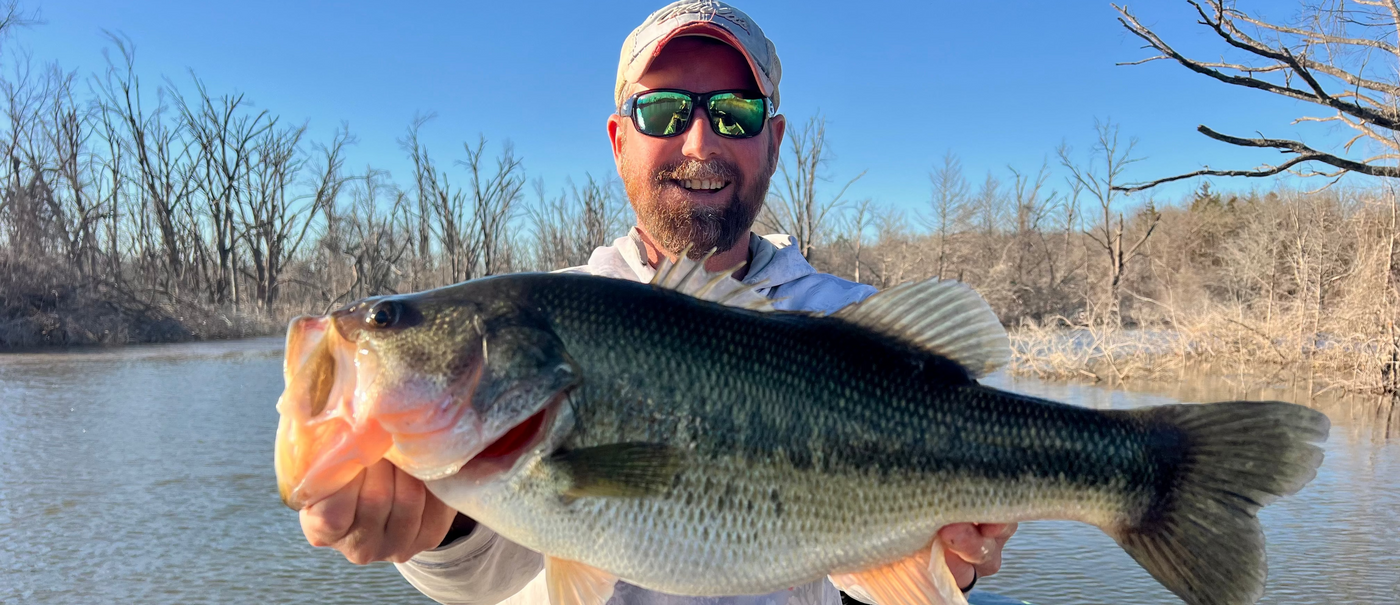
This is why Bois d'Arc is on the map. TPWD stocked it hard with selectively-bred Lonestar/Florida-strain largemouth, and on a young, food-rich lake they're growing fast — double-digit fish are already coming to the scale and the ceiling keeps climbing. Spring: shallow in the timber, coves and gravel beds on soft plastics, spinnerbaits, bladed jigs, squarebills, jerkbaits and frogs. Summer and winter: offshore on timber, channel swings and the mapped brush piles in 20–30 feet with Texas rigs, football jigs, deep cranks, Carolina rigs and big worms. Fall: shad baits — A-rigs, lipless, swimbaits. The big deal here is the 16-inch maximum length limit — every bass 16 inches and over must go back. That's not red tape, it's the plan: releasing the giants is exactly how this lake becomes a legend, so get the picture and let her swim.
Crappie — steady numbers in the timber
Crappie — steady numbers in the timber
If it's a bent rod you're after, the crappie deliver. The lake is loaded with timber and brush, and crappie use all of it. Spring: shallow on feeder creeks, cover and the bridge pilings — jigs and minnows both catch them. Summer into fall: deeper cover and brush piles in 10–20 feet, and the shaded FM 897 bridge pilings are the cool spot on a hot day. Winter: the deeper brush piles and submerged trees, where they stack up — forward-facing sonar shines for finding suspended schools. Bring plenty of jigs and hooks, because the dense cover will eat a few — that's the price of fishing where the fish live. Don't be shy about changing jig color and size until they tell you what they want.
Catfish — channels, blues & a live-bait surprise
Catfish — channels, blues & a live-bait surprise
Channel and blue catfish are active and eager here, and they're the easiest bite on the lake for bank fishermen and families. Fish cut bait, shad or stink bait along channel edges and flats, especially right after sunrise. A tip straight from the lake: live minnows fished for crappie down in the timber will get eaten by catfish, gar, drum, bass and sunfish too — so keep a heavier rod ready, because you never know what's about to load up. The forgiving, all-ages catfish bite is a great fallback when the bass get finicky on bright, high-pressure days.
White Bass — early-and-late fun
White Bass — early-and-late fun
Bois d'Arc has a solid white bass population and they're a blast when they school. Best action is early morning and the last light of the day, when they push shad to the surface — watch for busting fish and diving birds, then throw small spoons, swimbaits, inline spinners and lipless baits into the school. Through the day they roam open water and relate to offshore structure and channel edges, so your electronics earn their keep. When you find a school of whites feeding, it can be a fish a cast — a great way to keep kids and new anglers hooked while the bass rest.
Bluegill, Gar & the Mixed Bag
Bluegill, Gar & the Mixed Bag
The lake was stocked with bluegill sunfish as forage, and they're everywhere in the shallow cover — perfect for getting a kid their first fish on a piece of worm under a cork. Fishing the timber and creek arms with live bait, you'll also run into gar and freshwater drum, which pull hard and surprise a lot of folks. It all adds up to a lake where you rarely get skunked: if the bass won't play, something else will, and that's a big part of what makes a new, healthy fishery so much fun to explore.
Where to Launch
Bois d'Arc keeps it simple: three free public boat ramps built by the water district, open 24/7, with picnic areas and restrooms. Here's the part first-timers need to hear — there is no marina, no store, no gas, no camping and no swim beach anywhere on this lake. Fuel up, buy your bait and tackle, and grab food and ice before you head out, because once you're there, there's nothing but water and timber. Tap a card for directions.
← Swipe or tap the arrows →
FM 897 Ramp
Best all-around / middle of the lakeThree-lane concrete ramp · ~50 parking spaces · Restrooms · Picnic area · Open 24/7 · Free
The main ramp and the one to use your first trip. It's a wide three-lane ramp that handles anything from a kayak to a big bass boat, and it sits near the middle of the lake by the FM 897 bridge — so you can run west into the standing timber or east to the open water and brush piles without a marathon boat ride. Address: 740 County Road 2945, Dodd City. Located south of the 897 bridge off FM 2945, about 2.7 miles north of US 82.
Get directions →North 1396 Ramp
Quieter north endConcrete ramp · ~50 parking spaces · Restrooms · Picnic area · Open 24/7 · Free
On the north shore where FM 1396 meets the lake. This is the launch for folks who want to get away from the crowd and fish the less-pressured upper reaches and timber arms. On a lake that draws a crowd on weekends, putting in up here can mean water nobody's touched yet. Address: 1510 Old 1396 North, Telephone, TX.
Get directions →South 1396 Ramp
Lower-lake accessConcrete ramp · ~50 parking spaces · Restrooms · Picnic area · Open 24/7 · Free
On the south shore where FM 1396 crosses the lake. Best access to the lower, open reaches of the reservoir and the eastern brush-pile network — a good starting point in summer and winter when the fish are offshore and deep. Quieter than the main 897 ramp, too. Address: 1191 Old 1396 South, Windom, TX.
Get directions →Before You Go
Read this firstNo marina · No fuel · No camping · No swim beach · Stained water · Standing timber
Bois d'Arc is a working water-supply reservoir first and a fishing lake second, so it's bare-bones on purpose: nothing to buy out there and nowhere to stay overnight. Gas up the truck and the boat, load your bait, tackle, food, ice, flashlights and bug spray at the shop, and plan to launch and go. Overnight camping and long-term parking are prohibited at the ramps, and there are no designated swim areas. And the big one: this is a young, timber-filled lake with stumps right under stained water — run slow near the trees and watch your graph.
Lake info →Local Tips & Hidden Gems
Download the habitat map before you launch
Download the habitat map before you launch
This is the biggest edge on the lake and it's free. TPWD's Habitat Structure Viewer maps the 40-plus brush and rock piles NTMWD sank in the eastern half, with GPS coordinates you can load right into your graph. Pull them before you go and build a run of known fish-holding spots instead of idling around blind. On brand-new water with no history and few contour maps, that map is the closest thing to a cheat code you'll ever get.
Fish the timber edges, not just the timber
Fish the timber edges, not just the timber
Everybody throws into the thickest trees. The better play is often the edge — where the standing timber meets open water, a creek channel, or a depth change. Bass and crappie use those edges as highways and ambush points, and you'll lose far less tackle fishing the outside line than burying baits in the heart of the woods. Run your bait down the tree line and let them come to it.
The 16-inch rule is the whole game — release the giants
The 16-inch rule is the whole game — release the giants
On Bois d'Arc every bass 16 inches and up must go back, by law. But it's more than a rule: this lake is being grown into a trophy fishery on purpose, and every big female you release goes back to spawn more giants. Get your photo and measurement fast, keep her wet, and turn her loose healthy. The angler who releases a 7-pounder today is why somebody catches a 12 here in a few years.
New-lake fish are dumb — use it while it lasts
New-lake fish are dumb — use it while it lasts
Bois d'Arc bass haven't seen ten thousand baits yet. On young water, reaction baits and search lures shine because the fish commit instead of studying — a chatterbait, a squarebill, a spinnerbait covers water and gets bit. Lean into that now, because this window doesn't last forever; as any lake ages and gets pressured, the fish get smarter. Fish it aggressive while it's still green.
Fish nights and full moons in summer
Fish nights and full moons in summer
Summer days are hot and the lake gets busy with skiers and pleasure boaters. The fix: fish at night. Black spinnerbaits and bladed jigs throw a strong silhouette and vibration that bass find in the dark, and propbaits or buzzbaits over the timber can be dynamite on a full moon. You'll beat the heat, beat the crowd, and often catch the biggest fish of the trip. Bring plenty of light and bug spray.
Let your electronics do the walking
Let your electronics do the walking
A 16,000-acre lake full of timber is a lot to search blind, so this is a forward-facing-sonar and side-imaging lake as much as any in Texas. Use your graph to find suspended fish on the brush piles, schooling bait in open water, and the fish relating to the deep trees in winter, then make targeted casts. If you're serious about the offshore game here, good electronics aren't a luxury — they're the difference-maker.
Run it slow, get home safe
Run it slow, get home safe
We'll keep saying it because it's the one that hurts: this is a young lake full of stumps just under stained water. Idle in and out of the timber, keep your speed sensible on unfamiliar water, and watch your graph for the trees that haven't rotted down yet. A destroyed lower unit or prop turns a great day into an expensive tow. Know the lake before you go, and when in doubt, slow down.


Your Last Stop Before Bois d'Arc
Load Up Before You Launch
There's no marina, no store and no gas at Bois d'Arc — so we're your last stop for bait, tackle, ice, your license and a fresh report on the way north. Tell us you're headed to Bois d'Arc and we'll get you rigged for the timber and pointed at the bite. Order online and pick up in store to save time.
Open 7 days a week 6am-6pm
10081 US-271, Powderly, TX 75473
Bois d'Arc Lake — FAQ
Why is there so much standing timber, and is it safe?
Why is there so much standing timber, and is it safe?
Much of the timber was left in place on purpose for fish habitat and water quality, especially west of the FM 897 bridge. It makes great fishing but it's a young lake with stumps just under stained water — run slow near the trees and watch your graph.
Is there a size limit for bass on Bois d'Arc Lake?
Is there a size limit for bass on Bois d'Arc Lake?
Yes — a 16-inch maximum length limit for largemouth bass. Every bass 16 inches or longer must be released. It's designed to grow the lake into a trophy fishery, so the big ones go back. All other species follow statewide regulations.
When did Bois d'Arc Lake open, and how big is it?
When did Bois d'Arc Lake open, and how big is it?
Bois d'Arc filled in 2021 and opened to the public in 2024 — Texas's first major new reservoir in over 30 years. It covers 16,641 acres with a maximum depth around 70 feet.
Where can I launch a boat on Bois d'Arc Lake?
Where can I launch a boat on Bois d'Arc Lake?
There are three free public boat ramps operated by the water district (NTMWD): the FM 897 ramp near the middle of the lake, and the North and South FM 1396 ramps. All are open 24/7. There is no marina.
Is there camping, gas or a store at Bois d'Arc Lake?
Is there camping, gas or a store at Bois d'Arc Lake?
No. There's no marina, fuel, store, or camping, and no designated swim areas. Fuel up and buy bait, tackle, ice and food before you go — Brannan's Bass Shop in Powderly is a good last stop on the way.
How far is Bois d'Arc Lake from Paris, Texas?
How far is Bois d'Arc Lake from Paris, Texas?
About 40 minutes northwest, up around Bonham in Fannin County. Brannan's Bass Shop in Powderly is right on the way for bait, tackle and your license.
What fish are in Bois d'Arc Lake?
What fish are in Bois d'Arc Lake?
Largemouth bass (the headline — a stocked trophy fishery), crappie, white bass, channel and blue catfish, plus bluegill sunfish and some gar and drum. It's best known for fast-growing largemouth.
Do I need a fishing license for Bois d'Arc Lake?
Do I need a fishing license for Bois d'Arc Lake?
Yes — a Texas fishing license is required for anglers 17 and older. You can buy and print one in store at Brannan's Bass Shop.
